Sermon for August 9th, 2026
Matthew 14:22-33 (NRSVUE)
There’s a book that came out a while back called If You Want to Walk on Water, You’ve Got to Get Out of the Boat. Good title. Catchy. And it captured, better than almost anything else out there, how most of us have been taught to read this story. Peter had guts. Peter had faith. Peter did the one thing none of the other eleven were willing to do… he swung his legs over the side of that boat and he walked. Heck, John Welsey himself wrote his commentary on this text in 1754 with the same viewpoint! And the sermon that usually rides in on the back of that reading goes something like this: keep your eyes on Jesus, don’t look at the wind, don’t look at the waves, and you too can do the incredible.
I’ve preached some version of that sermon myself. Maybe you’ve heard it a dozen times. There’s nothing hurtful about it. Courage matters. Faith that stays seated and never risks anything isn’t much of a faith at all.
But here’s the problem. When the story ends, and Peter and Jesus climb back into that boat soaking wet, the other disciples don’t slap him on the back. Nobody says “way to go, man, almost had it.” They fall down. And they worship. Not Peter, but Jesus. The hero of Matthew 14 was never the guy who got wet. It was always the man who came walking across the water like he owned the place. Because he does.
So before we go further, let’s set the scene, because context tells you almost everything you need to know about why this story unfolds the way it does.
To remind us about where we were last week, Jesus has just heard that his cousin is dead. Not a natural death. Herod had John the Baptist’s head cut off and served on a platter at a party. That’s the news Jesus is carrying when this chapter opens. And what does he want? What any of us would want. Space. Quiet. A place to grieve a man he loved.
He doesn’t get it. The crowds find him anyway. And instead of sending them away, Jesus does what he always does, he has gut-level compassion on them, he heals their sick, and by the end of the day he’s fed five thousand families with a sack lunch. Ministry doesn’t wait for us to be ready for it. Anybody who has ever stood up to preach a funeral the same week they buried their own family member knows exactly what I’m talking about.
So Jesus finally gets his moment. He sends the crowds home. And then, look closely at the verb here, he makes the disciples get into the boat. Some of your Bibles will say “made them get in.” The word behind that is a strong one. It means to compel, to force, to give no option. This was not “hey guys, why don’t you head out ahead of me.” This was Jesus putting them in that boat the way a teacher slides a pop quiz onto your desk. You didn’t ask for it. You’re not ready for it. It’s happening anyway.
And then Jesus goes up the mountain, alone, finally, to pray. To grieve. To rest. Jesus doesn’t apologize for needing that time. He doesn’t pretend the crowd’s needs outrank his own soul. He goes and he’s quiet with his Father, and only after that does he come down to find his friends.
Meanwhile, out on the water, things have gone bad. Matthew doesn’t just say the boat got tossed around. The word he uses, and hold on for this one, basanizomenon (bah-sah-nee-ZOH-meh-non), is the same word he uses a few chapters earlier for demonic torment. This wasn’t a little chop on the lake. This was a boat being worked over. Hour after hour, in the dark, arms burning, ropes slipping, nobody sleeping. By the fourth watch of the night, that’s somewhere between three and six in the morning, these men have nothing left. Every skill they have as fishermen, every trick they know for handling a boat in weather, has already been spent. They are done.
That is exactly the moment Jesus shows up. Not before the storm. Not to prevent it. In the middle of it, when they’ve run out of themselves.
He comes walking on the water. And they don’t recognize him. They think he’s a ghost, and they scream. Which tells you something… after everything they’ve seen this man do, feeding thousands, healing the sick, they still don’t expect this from him. Grief and exhaustion, I’ve noticed, tend to strip away our capacity for wonder. When you’re that tired, even a miracle looks like a threat.
So Jesus says three things to them, and it’s worth slowing down here because this is the center of the whole passage: he says, “Take heart. It is I. Do not be afraid.”
That middle phrase, “It is I”, most of our translations smooth it over. “It is I.” “It’s me.” Perfectly reasonable English. But the Greek is bare. Ego eimi. Just, “I am.” No object. No predicate. He doesn’t say “I am your teacher” or “I am your friend.” He says the same two words God spoke out of a burning bush to a shepherd named Moses who was hiding out in the desert with a murder charge on his record. “I AM WHO I AM. Tell them I AM sent you.”
And there’s more. In the book of Job, God asks Job a question out of the whirlwind. God asks… have you ever walked the recesses of the deep, have you ever gone where the springs of the sea begin? The implied answer is no. Only God has walked there. Only God tramples the waves. That’s language for the Creator, for the one who set the boundaries of the ocean before the earth had a name.
So when Jesus walks out across the Sea of Galilee at three in the morning and says “I am,” Matthew isn’t just telling you a nice story about a man doing something extraordinary. He’s telling you exactly who’s in the boat with you. This is the same voice from the bush. This is the same authority that walked the deep before there was a Peter to sink into it.
And that’s where Peter, being Peter, opens his mouth.
“Lord, if it is you, command me to come to you on the water.”
Now, like I said… I know how we’ve been taught to hear that line. Bold Peter. Faithful Peter. The one disciple willing to take the risk. But look at that phrase again… “if it is you.” That exact construction shows up three other times in Matthew, and none of them are flattering. The devil uses it in the wilderness: “If you are the Son of God, command these stones to become bread.” The high priest uses it at Jesus’s trial: “If you are the Messiah, tell us.” The men mocking him at the cross use it too: “If you are the Son of God, save yourself.”
Every single time somebody in this Gospel says “if you are,” they’re not asking a sincere question. They’re issuing a challenge. They want Jesus to perform, to prove himself, to put on a show that settles the matter on their terms instead of trusting the terms he’s already given them. What if Peter isn’t stepping out in humble faith here? What if Peter is testing the very one who has just finished testing him with a storm? What if he wants to walk on water not because Jesus told him to, but because he wants a demonstration?
And here’s grace for you. Jesus lets him come anyway. “Come.” One word. No lecture first, no warning. Because that’s who Jesus is. He doesn’t wait for our motives to be pure before he extends his hand.
So Peter gets out. He walks. For a few steps, gravity forgets he exists. And then he notices the wind, and he’s afraid, and he starts to go under, and he cries out three words that are, frankly, the best theology in this whole story: “Lord, save me.”
Not “Lord, help me try harder.” Not “Lord, strengthen my focus.” Just — save me. That’s the whole gospel in three words. That’s every prayer any of us has ever prayed worth praying.
Jesus reaches out immediately and catches him. No hesitation. And then he says something that gets read as a rebuke or punishment but might be closer to a compassionate diagnosis: “You of little faith, why did you doubt?” Not “why did you fail my test,” but why did you doubt the one who is already, right now, holding your hand.
They climb back into the boat together. And the moment Jesus is back with the others, not off doing something spectacular alone with Peter, but back with the whole crew… the wind simply stops. And the men in that boat do something Matthew has not recorded them doing before in this entire Gospel. They worship him. “Truly you are the Son of God.”
Highlight that phrase in your Bible. Write it down, because Matthew wants you to remember it. He only uses it one other time in the whole book, at the foot of the cross, when a Roman centurion watches Jesus die and says the exact same words: “Truly this was the Son of God.” The storm on the lake and the darkness over Golgotha are bound together by that one confession. What the disciples figured out on the water in the middle of the night, a pagan soldier figures out watching Jesus breathe his last. This man is who he says he is. And the salvation he offers isn’t only from drowning. It’s from everything that would otherwise drown us for good.
So here’s what I want you to walk away with this morning, and it’s not “get out of the boat if you’re bold enough.” That’s a fine motivational poster, but it’s not what Matthew is giving us.
What Matthew is handing us is this: Jesus is Lord over the storms you didn’t choose and the ones he compelled you into. He is present in your exhaustion, not just your triumphs. He shows up at the fourth watch, not the first… which means if you’re still waiting on him at three in the morning, you are not off his radar. You are exactly where this story says he meets people.
And notice… the miracle worth savoring here isn’t that a man walked on water for a few seconds before he sank. If Jesus is who he says he is, walking on water is no bigger a stretch for him than you walking up a flight of stairs. The miracle is that a boat full of exhausted, grieving, frightened men looked at this soaked, ordinary-looking rabbi climbing back over the side and recognized, right there in the middle of nowhere, in the dark, that God’s own Son was standing in front of them.
Most of us are not going to be asked to walk on water this week. Most of us are going to be asked to keep rowing.
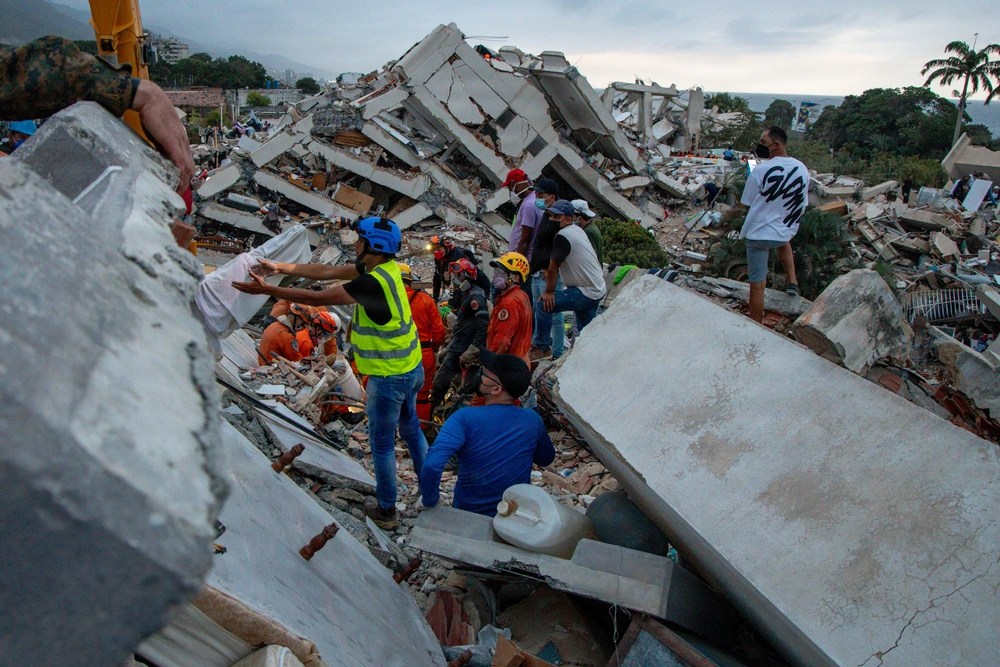
You want a picture of what that looks like? Look at what happened in Venezuela this summer. Two horrific earthquakes hit within a minute of each other in June, magnitude 7.2 and 7.5, and by the time the ground settled, over a thousand people were dead and thousands more were buried under what used to be their homes. Fairfax County, Virginia’s search and rescue team was on a plane within two days to Venezuela. Los Angeles County, California sent seventy-one more behind them, with six dog teams, and eighty-four thousand pounds of gear. For ten straight days those rescue teams worked that rubble in shifts, no real sleep, digging by hand where the machines couldn’t reach.
They pulled a mother and her nine-month-old out alive. They freed a father and his son who’d been trapped under a collapsed building for four days. Nobody filmed the whole thing for a highlight reel. Most of it was slow, and dark, and unglamorous, hour after hour of listening for sounds of life under concrete. When they finally flew home, the Venezuelan government handed them their flag and said thank you. That’s the whole story. Nobody got out of a boat to walk on water. They just stayed in the storm until the job was finished.
To stay in the boat with people as a connected community; through weather we didn’t ask for; believing that the one who compelled us into this thing in the first place, hasn’t left us to figure it out alone. That’s not a lesser calling. Peter got a few seconds of spectacle and then needed rescuing. The rest who stayed in the boat got to watch Jesus walk the deep and then sit down among them, soaking wet, fully present, still Lord.
So if you’re in a storm you didn’t pick; a diagnosis, a grief, a classroom or a career or a marriage that’s taking on water faster than you can bail, hear what Jesus said to men who had nothing left to give: Take heart. I am. Don’t be afraid.
He’s not calling you to be Peter this week. He’s calling you to keep your hand on the oar, to stay with the people he’s put in the boat with you, and to trust that the wind stops the moment he climbs back in. Not because you were brave enough, but because he is who he says he is.
Amen.
Sermon by: Rev. Dave Wasson


Leave a Reply